LK Systems LK Group LK Pro login English
Close

LK Group

Underfloor-heating-kitchen-floor-passive-underfloor-cooling

Underfloor cooling

Comfortable cooling during spring, summer and autumn

LK Underfloor Heating with a Cool Bonus: Underfloor Cooling

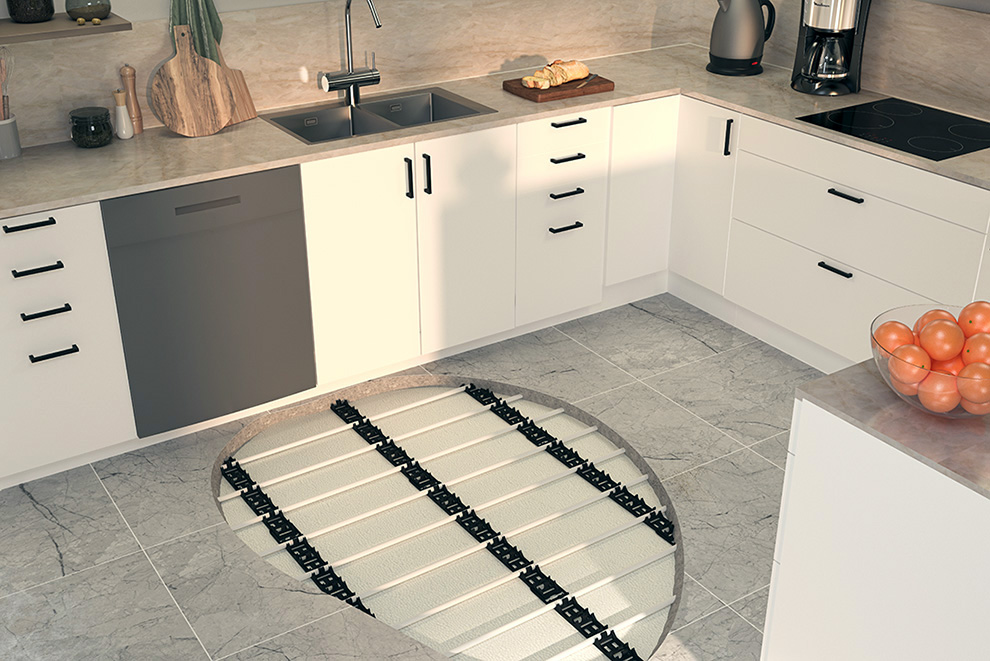
Provided that the underfloor heating pipes are cast into concrete or self-levelling compound, or installed in LK CombiBoard EPS, the same underfloor heating system that heats the building during the heating season can also be used for passive underfloor cooling. This means the system provides comfortable heat in winter and pleasant cooling during spring, summer and autumn. Underfloor cooling uses passive cooling from rock, groundwater or a surface ground collector. This makes operation virtually cost-free, apart from the energy required by the pump circulating water through the system.

pipes-floor-kitchen

Underfloor cooling offers several advantages compared with active fan-based cooling systems

  • Much lower operating cost
  • Silent operation, with no noisy fan motors
  • Reliable operation, with only a few moving parts
  • Bonus function: the same pipes and manifolds used for heating during the heating season are used for cooling during spring, summer and autumn

Points to consider

Choose floor materials that can withstand high relative humidity, such as ceramic tiles. Solid wood flooring is generally not recommended, as it can move significantly with temperature and humidity changes across the seasons. Contact your flooring supplier for recommendations on suitable floor finishes.

  • To avoid condensation, the lowest permitted supply temperature must be selected carefully. The temperature must not fall below 18 °C in order to reduce the risk of condensation.
  • For the best effect and comfort, solar gain should be limited during the summer using solar shading, awnings or similar solutions.
  • Suitable underfloor heating systems for underfloor cooling include LK Clip Rail Combi 16/20, LK System Plate 30, LK Foil Board Silent and LK CombiBoard EPS.
  • In larger buildings, installation of an air handling unit with air drying should be considered.
  • LK Arc Room Temperature Control supports underfloor cooling.
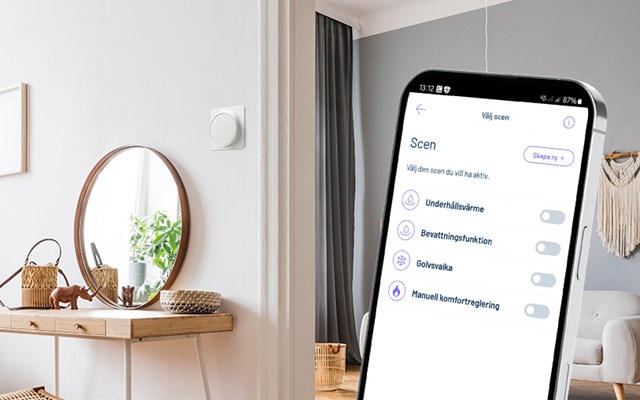
mylk-app-Underfloor-cooling

System control with LK Arc Room Temperature Control

Using the MyLK app, the user selects which operating mode LK Arc Room Temperature Control should use: underfloor heating or underfloor cooling.

If LK Arc Room Temperature Control detects elevated humidity values on at least two circuits, the system closes all circuits until the relative humidity falls below the set value again.

A wired LK ArcSense should be installed in the system’s manifold cabinet to measure humidity. This enables the system to respond as early as possible to elevated humidity levels.

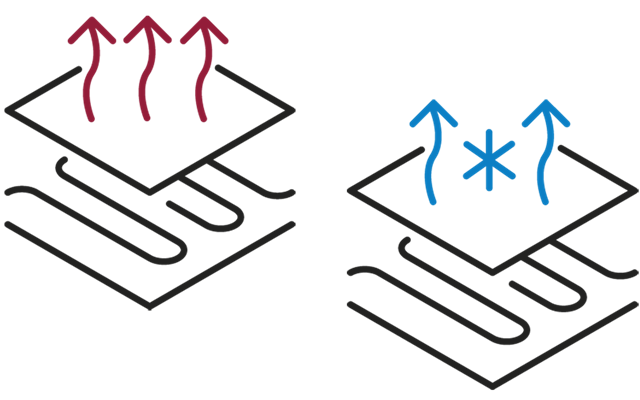
Underfloor-cooling-heating-symbol

Cooling output with underfloor cooling

It is important to have the right expectations. Underfloor cooling is primarily a comfort function. It provides cooling, but it does not work like a conventional air-conditioning system. This means you cannot set the system to 21 °C and expect the house never to become warmer than that, regardless of weather conditions and solar gain. As a rule of thumb, underfloor cooling can remove approximately 15 W/m² at an indoor temperature of 24 °C.

To achieve good results, heat gains in the building must also be limited. This applies particularly to strong solar radiation through windows.

  • Use solar shading, awnings or blinds where possible
  • Avoid airing the building when it is warmer outside than inside
  • Remember that large rugs and dense furnishing reduce the effect

A basic rule is that the supply temperature for underfloor cooling should never be lower than 18 °C.